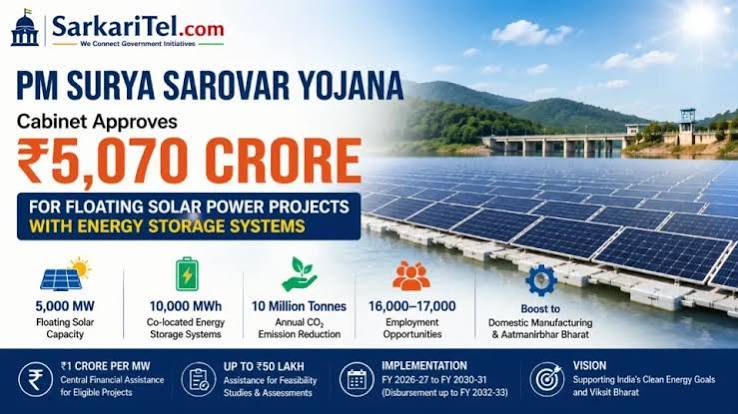





The Union Cabinet has officially cleared the Pradhan Mantri Surya Sarovar Yojana, allocating ₹5,070 crore to support the installation of 5 gigawatts (GW) of floating solar power capacity paired with battery energy storage systems. The initiative aims to accelerate India’s renewable energy targets by utilizing the surfaces of reservoirs, lakes, and other water bodies rather than acquiring valuable agricultural or urban land. Floating solar installations, also known as floatovoltaics, offer a dual advantage by reducing water evaporation losses in hot regions while simultaneously benefiting from the cooling effect of the water, which improves solar panel efficiency. The approved funding will provide central financial assistance to public and private developers through FY2032-33, encouraging investment in integrated energy storage technologies that ensure grid stability. Under the guidelines, priority will be given to large-scale hydro-electric dam reservoirs, where existing transmission infrastructure can be shared to lower overall project costs. Environment officials have noted that thorough ecological assessments will be required for every project site to protect aquatic biodiversity and prevent disruption to local ecosystems. The initiative aligns with India’s broader commitment to achieve 500 GW of non-fossil fuel capacity by 2030, offering an alternative pathway for state governments struggling with land acquisition hurdles. Industry analysts expect the scheme to attract significant private investment and drive local manufacturing of specialized floating platforms and corrosion-resistant mounting structures. Power distribution companies are expected to benefit from localized generation, which reduces transmission losses and helps meet peak daytime electricity demand. The Ministry of New and Renewable Energy will oversee the deployment, issuing tenders for the initial phase within the coming quarters. Key industrial hubs and water-stressed agricultural states are expected to be the primary beneficiaries of the initial allocations. The announcement has been welcomed by clean energy advocacy groups, who view water-based solar as an effective solution to land constraints in densely populated states. Implementation phase timelines will require developers to commission projects within 24 months of allotment to ensure rapid scaling. State agencies are already identifying potential reservoirs suitable for floating solar arrays to prepare for upcoming bidding rounds. With this scheme, India aims to position itself as a global leader in floating photovoltaic deployment and battery integration.
Union Cabinet Approves ₹5,070 Crore Floating Solar Project Scheme to Boost Clean Energy